• Fuel The Work – Exercise, Carbs and Insulin

    I’ve been a distance runner and nordic skier since high school. Managing blood sugar while training is a pain – hypoglycemia can be dangerous while hyperglycemia makes you feel like garbage. Any deviation from ideal glucose reduces performance, blunts recovery, and has long term health consequences. So how can you manage blood glucose during intense exercise? There’s a lot to talk about here. When should you turn off or remove your insulin pump? Should you be constantly downing granola bars and gels? How does exercise duration affect glucose? What about intensity? Does exercise mode on the pump really do anything? And what can we do after finishing a workout to prevent glucose excursions?

    Fuel for Insulin on Board

    Exercise dramatically and temporarily increases insulin sensitivity. That is, sensitivity to the insulin currently acting in the body. Remember that “rapid acting” insulin’s effect rises to a peak between 1 and 1.5 hours and slowly trails off. For this reason, during a 30 minute run, the most important predictor of low blood sugar is not what the pump is doing during the run, but how much insulin is in your system in the one to three hours prior to the exercise.

    Short Stuff

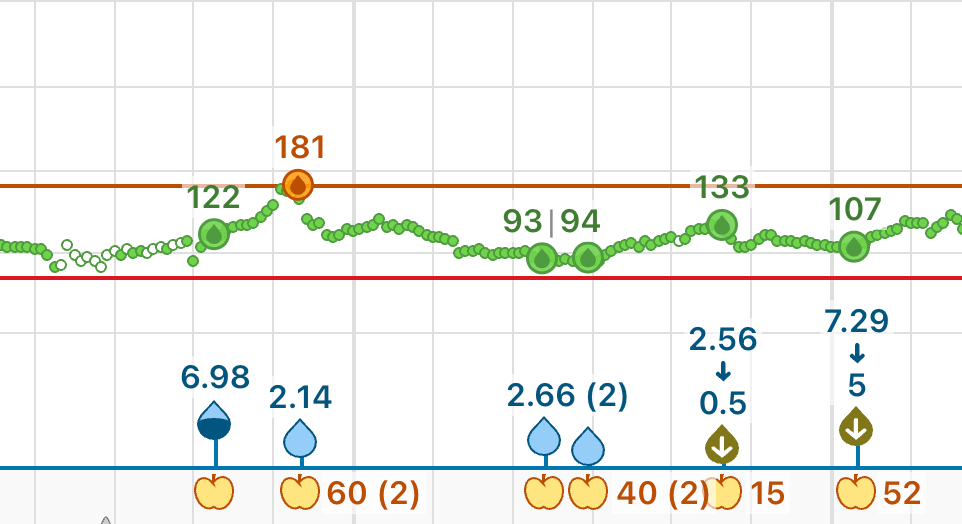
    For shorter efforts, any reductions in insulin must come before the exercise rather than during. I do most of my short casual runs first thing in the morning, and I typically train fasted and leave my pump on. I’ve found that suspending or taking off my pump for short duration exercise only results in post-exercise high blood sugars and yields no benefit in preventing hypoglycemia during less than 30 minute workouts. If training between 30 minutes and an hour, eating a granola bar or gel around 15-30 minutes in and another 45 minutes in usually works OK to prevent lows. Alternatively, taking off the pump typically prevents almost all lows during morning runs, but can lead to under-fueling.

    Long Stuff

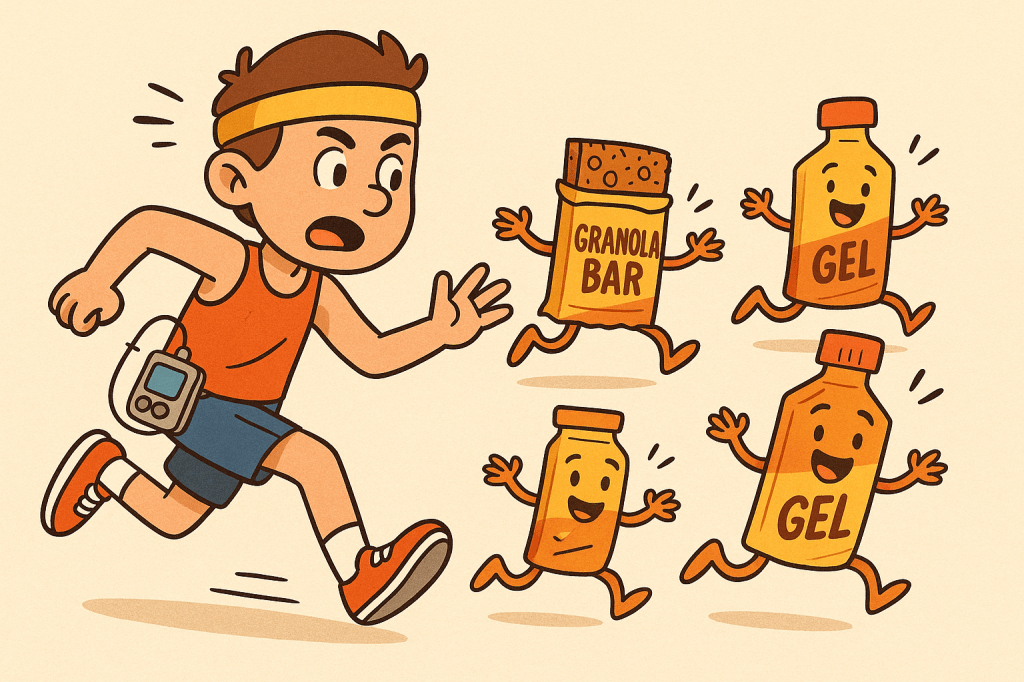
    During long hard efforts like a multi-hour trail run, if I have insulin on board I need to consume tons of carbs to prevent my number from going low. One option is to disconnect the pump before and during these efforts to prevent lows. While this can work, I find my number tends to start high then either stay high or crash. To avoid starting high, I prefer to keep the same amount of insulin on board and fuel consistently starting 15 minutes before I begin my workout. That way my number doesn’t skyrocket before I start nor does it plummet in the first half an hour of work. If I keep my pump at its normal basal rate, I can eat pretty much any quantity of carbs during a sufficiently hard effort and my number rarely goes above 120. Carrying so much food can be challenging, and I’m not sure that eating ten sugary granola bars during a two hour trail run does my teeth any favors. That said, there is a shift towards high carb fueling for long duration exercise, and this approach allows type 1 diabetics to follow a high carb fueling strategy without spiking blood glucose.

    Intensity

    Intense, short duration exercise fails to lower my blood sugar the way longer duration cardio workouts do. For me, I rarely have an issue when lifting weights or running a track workout. For longer stuff like mountain runs and tempo runs, higher intensity typically means more insulin sensitivity, more fuel required, and a greater risk of lows. So where’s the cutoff? My best guess is that there are two factors at play – acute stress and total energy expenditure. Stress tends to make us insulin resistant. Energy expenditure causes the muscles to suck up glucose and make us insulin sensitive. Doing three sets of ten squats to failure puts a ton of stress on the body, but doesn’t actually burn that many calories. Even a brutal track workout like 12×400 or mile repeats don’t result in tons of calories burned compared to a two hour mountain run. Long slow cardio burns a ton of energy but puts relatively little stress on the body.

    Fasted Training

    It is possible to start without much insulin on board and fuel minimally. For me, this typically means training first thing in the morning. I find that running first thing in the morning has a few benefits. First, it helps me reduce or entirely avoid the rise in glucose after waking, otherwise known as the dawn phenomenon. Since there’s minimal insulin on board when I wake up, my glucose tends not to fall as quickly. In the morning I can typically go for an hour long run without eating anything and not experience hypoglycemia. While this is ideal in terms of maintaining a stable blood sugar, the lack of fueling both limits performance and might fatigue my body unnecessarily. While it’s anecdotal, the only time I recently got an overuse injury running was when I routinely ran 13+ mile fasted morning runs.

    Insulin Pump Exercise Mode

    Exercise mode claims to reduce basal insulin and corrections on closed loop insulin pumps. Personally, I find it next to useless. It’s delivers way too much insulin to train without substantial fueling (in which case, I’d prefer to leave the pump in its normal setting), fails to keep my number in check when I fuel heavily, and I frequently forget to disable it after my workouts. More broadly, a one-size-fits-all exercise mode fundamentally doesn’t make sense to me. Does exercise mean a stroll around the neighborhood, going for a leisurely long run or competing in a 5k? What about a track workout, nordic skiing, or yoga? I get the sense they cater more to walks around the block than marathon training, though I find that even during a leisurely round of golf my number goes low in exercise mode. Has anybody had success using exercise mode? Maybe I’m missing something – let me know!

    Post Exercise and Recovery

    After finishing a workout, I find my insulin sensitivity quickly returns from hypersensitive during the run back to near normal levels. If my pump has been off, my insulin on board will be low and my number will climb quickly, especially if I eat. To counteract this, If I did take off my pump (something I’m trying to do less these days) I deliver a bolus a soon as I finish to approximately cover the missing basal during my run plus a pre-bolus for any food I’m planning to eat. I’ve found I need to increase this bolus in the morning to something like double the basal missed, likely due to dawn phenomenon and lower overall IoB.

    If I kept the pump on and fueled my work, I find my post exercise numbers are much more stable. If anything, I keep an eye out for lows since I find my sensitivity stays higher than baseline thus a normal correction or basal delivery might send me low.

    Conclusion

    Exercising is amazing for the body and type 1 diabetes need not limit the type, intensity or duration of exercise we can engage in. While carrying 400 carbs with me on a long run can be annoying, I find that fueling my work makes me feel great, perform great, and allows me to stay in range for the duration of my effort.

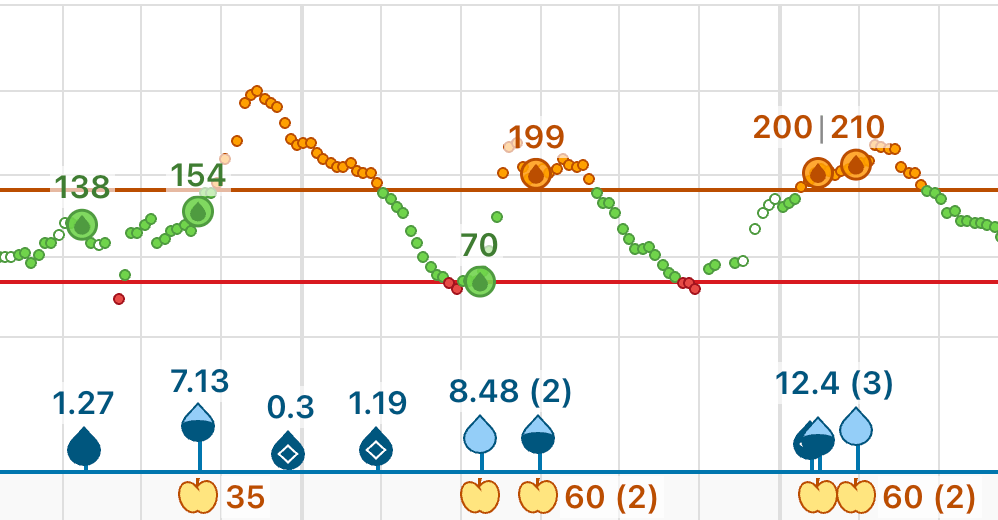
  • Over the past month I have been closely tracking my blood glucose while collecting and measuring strategies to improve control. I’ve found a few tricks that allow me to avoid glucose excursions and react effectively when I make mistakes.

    Bolus Before You Eat

    Anybody with T1D will tell you that getting meal boluses right is hard. Day to day my body’s insulin response varies, carbs are hard to estimate, and insulin doesn’t kick in right away. The “rapid acting” insulin I use isn’t that rapid at all, with 1-2 hours before peak effectiveness and a multi-hour tail.

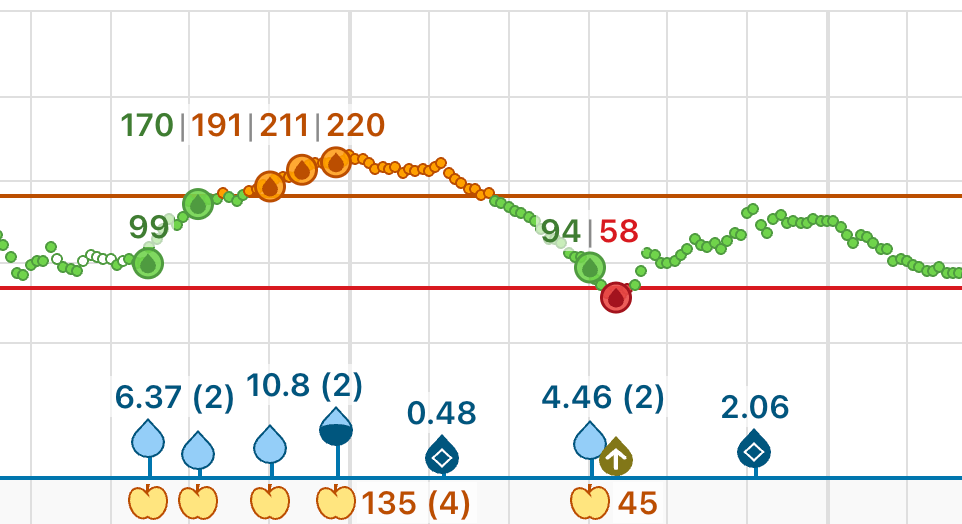
    The insulin onset delay makes excellent glucose regulation difficult. Notice that even when insulin is administered at mealtime, postprandial (after meal) glucose can rise followed by a low several hours later.

    A great strategy to avoid the mealtime rollercoaster is to pre-bolus, giving insulin 15-30 minutes before eating, or longer before if pre-meal glucose is high. A trace with “pre-bolusing” might look more like this.

    Notice how the bolus comes before the glucose rise, and how the overall line is flatter.

    Use “Exercise Snacks” to Correct Hyperglycemia

    Let’s say you’ve bolused and eaten a large, carb-rich meal. All too often, even with pre-bolusing and decent carb estimation, your glucose will rise and stay stubbornly high for hours after the meal. Let’s say you pump in a large amount of insulin to bring the glucose down. Insulin will only kick in after half an hour or so, and will peak after the food has been digested. This will usually lead to a low in 2-4 hours.

    Rather than delivering a large bolus and waiting, let’s say you do something to temporarily increase insulin sensitivity. I’ve noticed certain medium intensity activities always send my number low, so let’s use these to transiently sensitize ourselves to the insulin we already have on board. Snow shoveling*, wood splitting*, gardening, hitting golf balls into a backyard net and going for a brisk walk or jog all do wonders to bring my number down quickly.

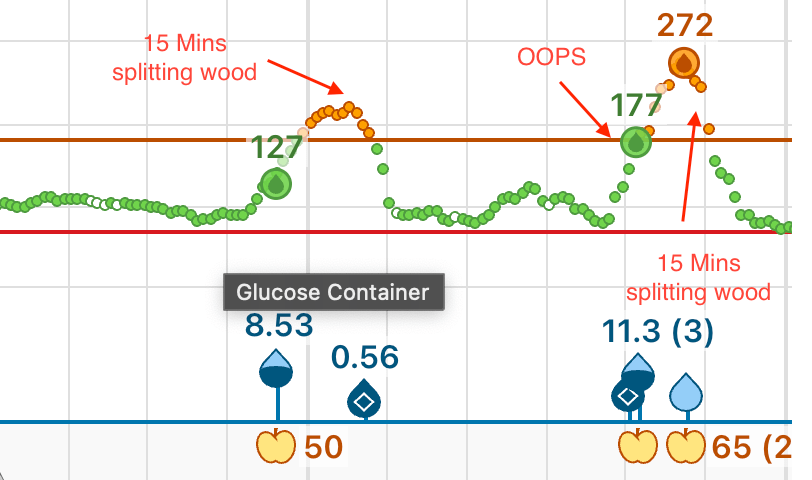
    In this trace, you can see how short duration activity (in this case splitting wood) quickly brought down my glucose without requiring more insulin and without the resulting hypoglycemia. Even with a completely forgotten bolus like in the second spike, the glucose comes down within an hour.

    Not everybody has a golf net in the backyard, never mind a pile of firewood to be split. Regardless, a brisk walk, pushups, air squats or any other medium to high intensity short duration exercise can help your muscles absorb the elevated glucose in your bloodstream. It’s also a chance to embrace being the weird person doing air squats in the airport or at work.

    * You can tell I’m writing this post in rural Massachusetts from my choice of esoteric activities like snow shoveling and wood splitting.

    Improve Insulin Sensitivity

    The topic of insulin sensitivity and metabolic health spans entire academic careers so it’s impossible to cover exhaustively. Regardless, I’d like to share a few tips that have personally helped me. Overall, I’ve found that common advice about food and exercise rings true. Eating a diet with lots of vegetables and fiber as well as a balanced mix of unsaturated fats and slow carbohydrates results in long term insulin sensitivity and better glucose control. While I’m still collecting evidence, I have anecdotally found that meals with excessive saturated fat result in insulin resistance. Exercise, especially long duration cardio like running, walking, cycling and cross country skiing result in improved insulin sensitivity during the activity and across the following day or more. Sleep interruption or deprivation causes insulin resistance. Stress causes insulin resistance. These are topics I want to investigate and quantify in future blog posts once I have collected more data, but I’m pretty confident about the directionality and causality of these inputs on insulin sensitivity.

    Ultra Rapid Acting Inhaled Insulin (Afrezza)

    Inhaled insulin is delivered directly to the bloodstream via the lungs, meaning it begins working almost immediately and is mostly cleared from the system after an hour. This makes it ideal for handling very high glycemic index foods as well as correcting stubborn hyperglycemia without a resulting low 2-4 hours later. See the follow chart comparing the action profiles of Afrezza (TI) and rapid acting insulin (RAA).

    Heinemann L, Baughman R, Boss A, Hompesch M. Pharmacokinetic and Pharmacodynamic Properties of a Novel Inhaled Insulin. J Diabetes Sci Technol. 2017 Jan;11(1):148-156. doi: 10.1177/1932296816658055. Epub 2016 Jul 9. PMID: 27378794; PMCID: PMC5375067.

    I will be trying Afrezza to rapidly correct hyperglycemia and report on my experience in a future post.

    GLP1 Receptor Agonists

    GLP-1 receptor agonists like Semiglutide (Ozempic) and Tirzepitide (Mounjaro) can slow gastric emptying (reducing postprandial highs), reduce cravings for high glycemic index foods and potentially, though possibly not directly, improve insulin sensitivity. There is existing work investigating GLP-1 receptor agonists in T1D with promising results. I have never tried this class of medications so I cannot add anything to the discussion, but it’s worth noting that they may provide a powerful tool for some type 1 diabetics.

    Conclusion

    Overall, leading a healthy lifestyle with lots of physical activity, a balanced diet and well planned meals has dramatically improved my glycemic control. Strategically timed physical activity can work wonders to reduce the duration and magnitude of hyperglycemia. I am still investigating the exact correlations between various foods and insulin sensitivity, as well as other tools like Afrezza. This post outlines my current understanding of the effect of lifestyle factors and medications on glycemic control. I will continue to share as my understanding changes while I collect more data and try more strategies.

  • Like many Type 1 Diabetics, I have a treasure trove of person data from my insulin pump, CGM and apple watch. Every six months, I meet with my endocrinologist to review my glucose trends and adjust my insulin pump profiles. I want to make it easier to analyze my own data and make adjustments between doctors visits. First, I downloaded my data and combined them into a single dataset. Next, I uploaded my data to ChatGPT and began asking questions.

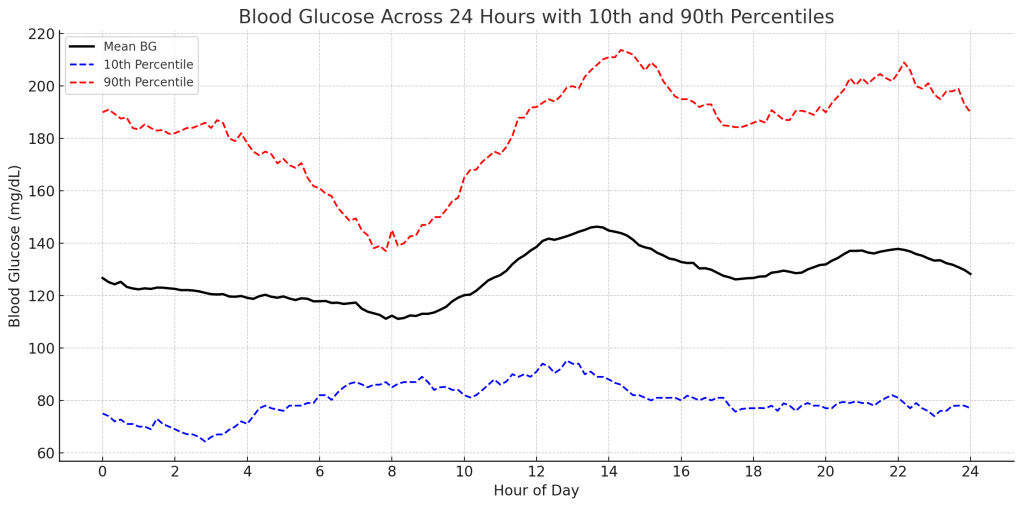
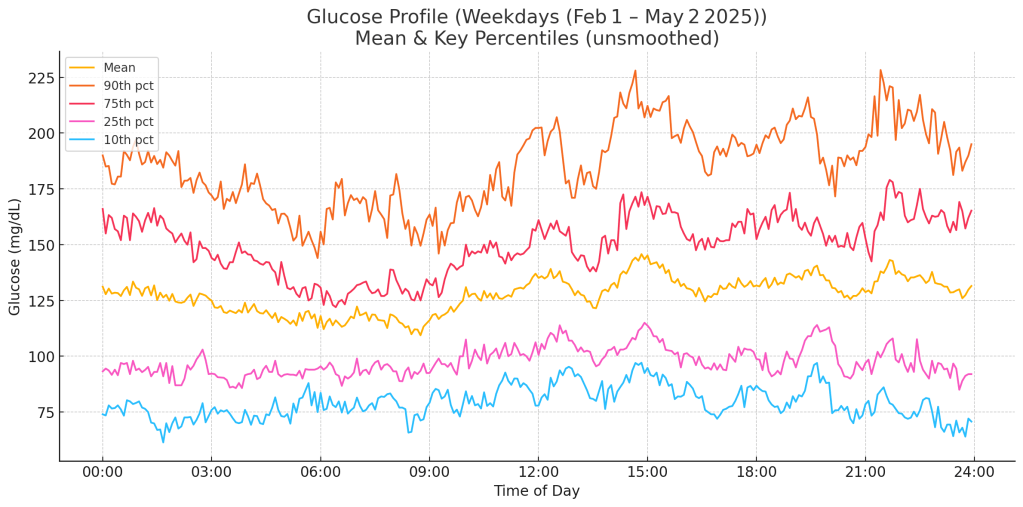
    I started by asking to show daily trends with average, 90th percentile and 10th percentile lines. This is similar to what I go over with my Endocrinologist, and it’s typically provided by the Tandem software. I can already see that I need to increase my pump’s basal rate and provide a more aggressive correction factor and carb ratio between 8am and noon. Let’s see if we can investigate further.

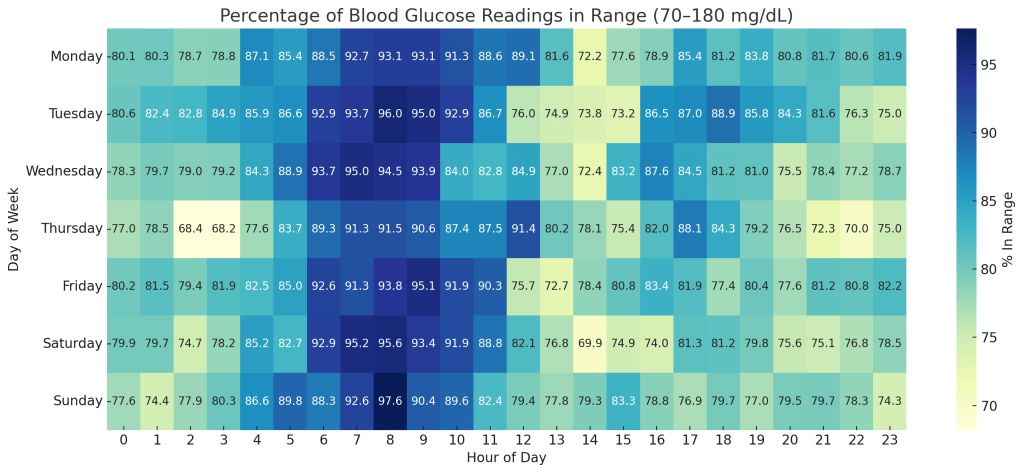
    Next, I asked ChatGPT to tell me how often my blood glucose is in range across the day. The sample size here isn’t enormous (~2k samples per block), but it’s enough to draw some conclusions. Again, it’s clear that I have issues between 10am to 2pm. Also, late Wednesday night into Thursday morning, late Friday into Saturday and to a lesser extent Saturday into Sunday appear to be issues. Interestingly I sometimes play in an online poker group during those times – perhaps the combination of distraction, stress and disrupted sleep are responsible for these periods of glucose excursion. Perhaps I need to avoid midnight snacks and be more mindful of avoiding late nights when I’m playing poker.

    The real power of creating a dataset like this becomes apparent when you want to start filtering the data. For example, I want to look at my glucose readings across the day but only for weekdays and only since the start of this year. It’s important to balance the desire to filter data with the need for enough data to generate a meaningful result. Here are a few charts I was able to come up with that have helped me.

    I notice a few interesting differences between weekdays and weekends. First, for some reason my dawn phenomenon (glucose rise after waking) seems to be much worse on weekends than weekdays. I speculate this is suppressed on weekdays because I’ve been going for a pre-work run almost every day during the week. Second, I often skip breakfast during the week but have more time to make breakfast on weekends, which could contribute to the glucose rise. Overall my weekends seem to have more glucose excursions, probably since my schedule varies more.

    With all these data, I can start making insulin pump profile adjustments for myself. Here are my profiles before I started.

    Time StartBasalCorr FactorCarb RatioTarget BG
    12:00AM1.41:251:7110
    6:00AM1.61:221:6110
    10:00AM1.41:241:7110
    5:00PM1.41:241:7110

    I had trouble getting ChatGPT to generate meaningful and effective changes to my profiles – it kept recommending that I change things in its text responses while changing nothing in the table it gave back. I’ll tackle this later – with my trends clear to me, I’m able to make some changes manually. I decided to change the profile times to reflect trends since I last updated my profiles. Below is the profile I changed to. Notice the morning chunk with high insulin doses now starts at 8am and ends at 1pm. I also toned down the overnight insulin to prevent early AM hypoglycemia, and upped late day insulin to bring the averages down between lunch and dinner. The resulting profile is below.

    Time StartBasalCorr FactorCarb RatioTarget BG
    12:00AM1.21:251:8110
    8:00AM1.61:201:6.5110
    1:00PM1.51:211:7110
    5:00PM1.31:241:8110

    I’ve also decided to reduce my total daily insulin from 60 to 45 units due to recent dietary changes I’m making alongside my new pump regimen.

    Every few weeks, I will re-upload my data and rerun some of these calculations. One of my goals is to streamline the process and share it so that others can do the same. Currently this requires some technical knowhow, but I’m hoping to make it easy enough that anybody can use these tools.

  • Something New

    Sometimes all it takes is a little nudge. I’ve been considering for over a year now, and I’ve finally decided to quit my job and dive headfirst into a passion project. It’s scary, exciting, and I have a lot to be grateful for, especially my friends, family and colleagues who listened to my thoughts and provided me the nudge to follow my passion.

    I’ve had Type 1 Diabetes (T1D) for 27 years and it’s been a constant in my life. While I was working at Google, I built and used a DIY closed loop insulin pump + continuous glucose monitor (CGM), piggybacking off the incredible work of the OpenAPS and NightScout Github projects. More recently I’ve been using a commercially available closed loop system.

    Technology has been incredibly helpful for me controlling my T1D. I was the youngest insulin pump user in my home state of Massachusetts at age 7, and a user of early CGMs. Closed loop pump + CGM artificial pancreas systems have been key to improving my control.

    Having worked eight and a half years as a software engineer in Silicon Valley, the time has come for me to come full circle and dedicate my efforts to better understanding T1D and exploring the role of machine learning in improving the closed loop systems I rely on. I look forward to sharing what I learn here on my blog!